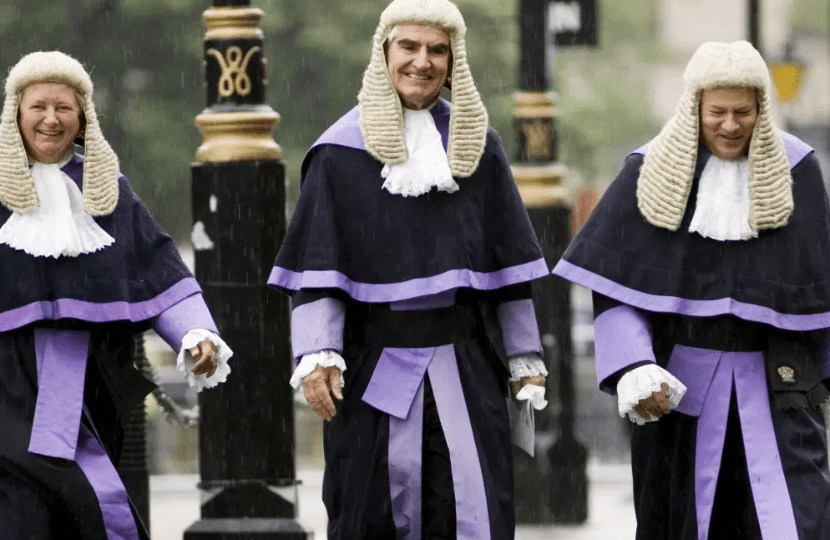
Contrary to popular belief, defendants in criminal trials can come from all walks of life. Some people accused of crimes might have grown up in poverty or spent their childhood years rotating around the country’s conveyor belt care system; however, others will have a university degree under their belt and may, though it is rarer to see, have enjoyed the privilege of a private education. In the UK’s criminal courts, you can expect to see both men and women in the dock, and they will be white, black, young, elderly. As long as you’re an adult, you may stand in those courts and be tried by your peers. It therefore seems logical that the judge sitting directly opposite you could be any regular person with a law degree. Alas, it doesn’t really work like that; it’s unfortunately a more predictable situation.
I recently read the end-of-year appointments list for High Court judges, and to say it was repetitive would be quite the understatement. Six of the newly appointed judges went to Cambridge, eight went to Oxford, and one studied at the University of London. Considering that less than 1% of the adult population attended either Oxford or Cambridge, it might be worth asking why 71% of senior judges went to the colloquial Oxbridge. A disproportionate amount of those judges had also attended independent schools. While some of the new judges were state educated, none were from a Black, Asian and Minority Ethnic background, despite pledges previously made by the Judicial Appointments Commission to increase diversity. But why is this a problem? To figure that out, you first have to consider the 2008 ‘job description’ of a judge – as given by the former Lord Chief Justice Igor Judge.
A judge must do right to all manner of people without fear, favour, affection or ill-will, the definition given by Lord Judge reads and many qualities are required for that. He or she must know the law and know how to apply it, and the judge must also be wise to ‘the ways of the world’. Judges must have moral courage to make unpopular decisions and to defend the right to equal treatment before the law.
Really though, it would be rare to find an Oxbridge graduate who knows what struggles are, given the pampered environment they will be familiar with – and their immunity from proper punishment. Perhaps we should look to the late Judge James Pickles for an honest comment; after all, his relentless description of one senior legal figure as a ‘dinosaur’ and another as a ‘pompous, toffee-nosed Etonian’ will surely be remembered throughout history.
A judge will need to demonstrate objectivity, but that isn’t always easy due to the deep-rooted human response known as affinity bias. It means, in essence, to prefer people similar to ourselves. By that logic, judges will be more inclined to sympathise with those coming from a ‘fiefdom of entrenched privilege’; whereas, if a judiciary is fairly diverse, affinity bias and lack of objectiveness will be less of a problem. As a result, no sympathy can be found from the judiciary for high-profile victims of miscarriages of justice. Lord Denning, the Master of the Rolls who attended Magdalen College, Oxford, can be quoted as saying that ‘the whole community would have been satisfied’ if a wrongful execution had occurred in the case of the Birmingham Six, and that the ‘appalling vista’ that was investigations into police corruption ‘should not go any further’. During his lengthy career he also described homosexuality as a ‘cult’ and said that black people were not ‘sufficiently qualified’ to serve on juries.
The situation is still far from perfect when you consider that the Conservative Party and Labour Party, as well as the Liberal Democrats, are led by white men in their late fifties who all attended fee-paying independent schools and graduated from Oxford, the elitist ‘Bullingdon Club’ university, in the 1980s. It is life experience that enables a person to relate to another; a judge could visualise an offence in their head, thus allowing them to accurately determine a crime’s seriousness – and to understand why a person turned to crime and whether there is any hope for rehabilitation.
Furthermore, there is a risk that public confidence in the justice system could be eroded. If somebody is the victim of a misdeed but has no faith in the process, they may choose not to report that misdeed, negatively affecting the administration of justice. It is also worrying because potential law students may be prompted to question their chances of success in the industry. According to Lord Neuberger, former President of the Supreme Court, the statistics suggest that ‘we do not have the best people’.
The two universities have produced 42 out of 55 Prime Ministers and can boast alumni such as Prince Charles, who was famously accepted into Trinity College, Cambridge, with two unimpressive A-levels (the minimum is supposed to be four). Perhaps it has something to do with the questionable admission procedures found at Oxbridge, described by David Lammy MP, Shadow Justice Secretary, as ‘the bastion of the old school tie’. In 2009, it was revealed that the inner-city London Metropolitan University had more black students than every Russell Group university put together. The judiciary is very similar to Oxbridge in that it is afraid of diversity – and, as a result, the underprivileged suffer.
 Elliot Tyler